
Worship

Praise the Lord.

Praise God in his sanctuary;
    praise him in his mighty heavens.
Praise him for his acts of power;
    praise him for his surpassing greatness.
Praise him with the sounding of the trumpet,
    praise him with the harp and lyre,
praise him with timbrel and dancing,
    praise him with the strings and pipe,
praise him with the clash of cymbals,
    praise him with resounding cymbals.

Let everything that has breath praise the Lord.

Praise the Lord.
Psalm 150

Worship is the one universal and unchanging commandment to the creation. Worship existed in heaven before the physical universe was created, and it will continue for eternity after this universe passes away. We, the creation, were made for the pleasure of him who created us.

In the church, we often confuse music for worship. Even in this, we find all sorts of impediments to worship. The sound is too loud. The song is too slow. The instruments are fighting for tempo. The music is too high. The leader didn’t pick the songs we like. That baby is crying again.

Add to these external distractions internal ones. I didn’t get enough sleep. I have work to do. I don’t want to miss the game. I’m mad at my spouse/children/boss/neighbor/…

And, if we dare to be truly honest, we hesitate to draw close to God because of our own unworthiness. It’s hard to praise God when I’ve been looking at pornography the night before. Or when I know that I’ve been defrauding my employer by not giving a full day’s work for the pay. Or when my selfishness has hurt the people I love.

But if we take a step back, and re-examine what worship is, there is a simple solution to all of these issues. Worship can be expressed through music, yes. Music is uniquely able to give voice to our emotions and to stir our hearts to express what might otherwise be inexpressible. Yet worship is more than music in the same way that poetry is more than words.

A dear friend and mentor suggested that, “Worship is the overflow of a heart that comes before God, expecting nothing.” Take a minute and ponder that. So many times we come to God with our Christmas wish-list of things we want him to do for us. Even godly things, like asking him to protect our children and to give us the strength to resist temptation. But if our interaction with God is based solely on what he can do for us, then it is self-serving and inverted. We are basically god, commanding our pet genii to do our bidding.

No, worship happens when we see God for who he is, and marvel. We experience his limitless grace and mercy and are speechless. We ponder his faithfulness in the face of our faithlessness and we are undone. We realize that he has given so much, done so much, is so much that all we can do is… worship.

So what do we do with all the impediments listed above? Get over yourself. It’s not about you. It doesn’t matter if the external environment is sub-optimal. God is worthy of your worship no matter what. Got things on your mind? Change your focus… it’s not about you. Wallowing in your sin? Come to the cross and be forgiven. And worship.

I can’t sing (melody) with many of the songs that are sung in our church today. Part of me longs to let my heart soar with the high notes that sound so good on the radio, but which just can’t come out of my mouth. Many times I can pick out a lower harmony, but somehow it’s just not the same. Frankly, I’m more likely to come into the presence of God in worship when I’m silent, and focused on him. Yet, one morning I heard God tell me “play the instrument you have been given.” So I sing the low notes and try to create harmony that is pleasing to the (my) ear, and hopefully pleasing to God.

Robert Gelinas suggests that the church should be like jazz. Different instruments interact, opposing and resolving, syncopating, handing the melody back and forth. Not all instruments are created equal. The sax and the trumpet seem to get more glory, but you can’t play jazz without a string bass. Each has it’s place in creating the tapestry.

One of the instruments I’ve been given is the ability to write. This blog is me, playing for the glory of God. It is he who puts the words in my head, he who helps me craft them into coherent thought and write them down. In giving this back to him, for the edification of his saints, it is worship.

For by the grace given me I say to every one of you: Do not think of yourself more highly than you ought, but rather think of yourself with sober judgment, in accordance with the faith God has distributed to each of you. For just as each of us has one body with many members, and these members do not all have the same function, so in Christ we, though many, form one body, and each member belongs to all the others. We have different gifts, according to the grace given to each of us. If your gift is prophesying, then prophesy in accordance with your faith; if it is serving, then serve; if it is teaching, then teach; if it is to encourage, then give encouragement; if it is giving, then give generously; if it is to lead, do it diligently; if it is to show mercy, do it cheerfully.
Romans 12:3-8

What instrument have you been given? Are you playing it? Are you playing it for yourself, or are you playing it for the Lord?

Let everything that has breath praise the Lord.

Praise the Lord!
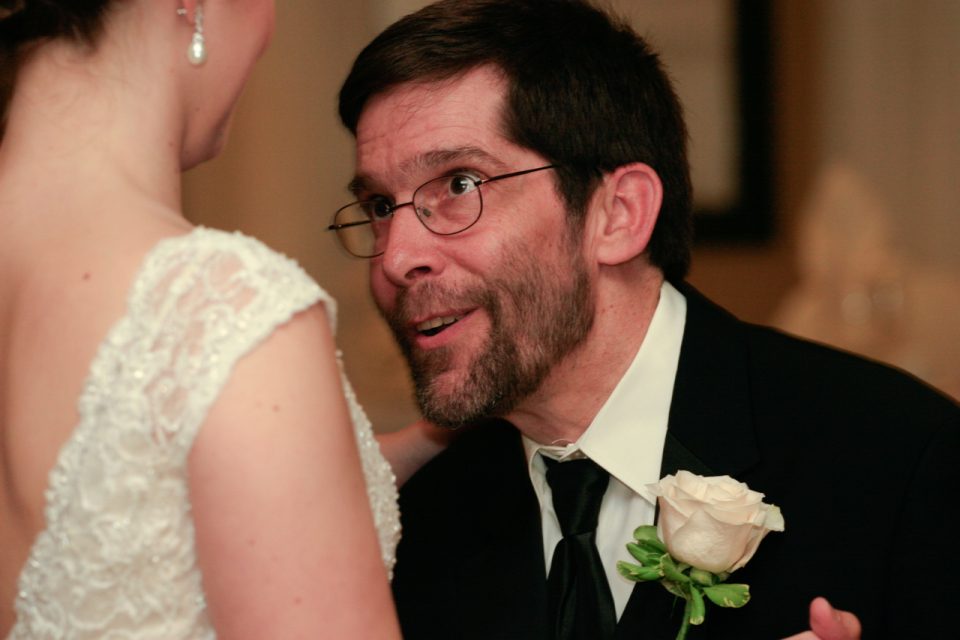
The Dance

Where there is no vision, the people perish
Proverbs 29:18a (KJV)

You wouldn’t think it would be like this. I mean, I spent close to 50 hours and hundreds of dollars training to build up my strength and endurance. I practiced and choreographed. You’d think it would be a big deal. Yet, now that it’s over, I find it very difficult to watch the video of the Father-Daughter dance at my daughter’s wedding. Even writing this blog has eluded me for months.

It’s not that we were horrible (we probably were, but it doesn’t matter). I had no expectations of excellence. I only wanted to get through it in one piece, and to honor my daughter by making this day everything she wanted it to be. Actually, I think it came out pretty well. Several people cried, so that was a success (I take perverse pleasure at stimulating other people’s emotions, even if my own are stunted).

No, the thing I find difficult is that seeing myself in a mirror or on camera stimulates a cognitive dissonance; the man I see on the screen does not correspond to the image I have of myself. This simply is not whom I see myself to be. I have a vision of me that is strong and confident, a leader in the workplace, in the church, and in my home. I terrify young men who want to call upon my daughters (ok, this isn’t necessarily spiritual, but it brings me great pleasure). I fully embrace the identity I have in Christ as a child of the great king, redeemed by grace and empowered to be more than an overcomer in this life.

This man… this man is small, weak. and crippled. He can’t stand up straight and moves awkwardly. Who could ever take this man seriously, much less respect him?

I was discussing this with a friend of mine, a former Air Force and commercial pilot who was suddenly struck blind. He is another illustration of this point, in that his blindness does not define him. We all treat him as just another friend, including the necessary occasional blind joke. When I mentioned what I was thinking to him, he said, “what do you mean by you are crippled?” Because he’s never seen me, he only knows the man I project, the one who matches my inner identity.

I have other friends who are strong and capable, but are crippled by a wounded and broken self-image. You probably have friends like that too. I see their brokenness played out on the internet as they find affront and defeat in every situation and vent about the injustice of it all on Facebook or Twitter. Rather than believing and resting in the truth of what God says about them, they pay attention to the lies that play over and over in their heads: You aren’t smart enough. You aren’t pretty enough. No one likes you. You’ll never amount to anything.

I’d like to be all super-spiritual about this, and claim that my vision is solely about the strength of God working in me which is greater than the physical limitations of my disease. But there’s a darker side to my view of myself, and that is self-denial. I don’t want to be crippled and limited, so I pretend that I’m not, until the reality of my body is shoved in my face. Even now, I find myself stuck in middle school, where more than anything I don’t want to be “different”. But I think there must be an aspect of self-denial, not to be limited by my body, my fears, my past, or any other thing that would keep me from being or accomplishing what I have been called to. Yes, these things are all true, but there is a truth greater than them, that supersedes their effect on my life.

The Christian life is all about faith, seeing that which is not as if it is. We are told that we are forgiven of our sin, and that sin no longer has power over us. Yet in my experience, I still sin. We are told that we are joint heirs with Christ, and that every spiritual blessing necessary for life and godliness is ours. Yet so often I feel impoverished and powerless. And so we believe, that which is not yet manifest will someday come to pass. We have a great hope in a coming salvation.

There is a great mystery of the Christian faith. God’s power is demonstrated through my weakness. The fact that I can be who I believe myself to be when shackled to a broken and uncooperative body is a testimony to God’s power. Yes, I am weak, so if God can do anything through me, he must be very powerful indeed. In this, my weakness brings glory to God. So, like Paul, “I will boast all the more gladly about my weaknesses, so that Christ’s power may rest on me.” (2 Corinthians 12:9)

Vision matters. Who you see yourself to be will ultimately govern who you are. I can do all things through Christ who strengthens me. What about you?

Simple Truth is sometimes best

You shall have no other gods before me.
Exodus 20:13

A friend of mine shared a link to another blog. It has been haunting me, because as a good Pharisee, I place a high value on being “right” Also, I’ve been doing a bit of thinking on idolatry, and have been challenged by the question “Life has meaning/I only have worth if…”

How do you fill in the blank?

Today, during worship I was reminded and confessed that my identity, my very reason for living is wrapped up in the fact that I am a sinner, saved by grace. My life has meaning because I have been forgiven of my sins by the grace of God and the blood of Jesus. My highest purpose is in bringing glory to the father.

I’m good with that.

What defines your life?

Questions and Answers

And we know that in all things God works for the good of those who love him, who have been called according to his purpose.
Romans 8:28

About 10 miles from my house, a well educated, intelligent young man went to a crowded movie theater, set off some tear gas, and shot 70 people, killing 12. While no one in my personal circle was hurt, I know people who know people who were hurt. The shocking thing is that it could have been any theater; the people shot could have been my friends, my family, even me. How do we respond to a situation like this?

How can a loving God allow evil in the world?

Perhaps you know someone who has asked this question. Perhaps you’ve asked it yourself. In my arrogance, I have an answer, but I know it won’t be satisfying. This is largely because the question is malformed.

Couldn’t God have stopped this man from killing those people? Of course he could. So if he could, and did not, then is he really loving? I mean, look at all the suffering and tragedy. To have in your hands the power to prevent the senseless bloodshed and suffering and fail to act is monstrous. So clearly, God (if he exists), cannot be loving. Or else, he can’t be all-powerful. In any event, I’m better off on my own. Who needs that God anyway?

The simple answer to the question is that a loving God allows people to make their own decisions, including the decision to reject him, or to accept his mercy and forgiveness through grace. In his love, he allows each one of us to set the course of our lives and to walk in the responsibility of our decisions. This means allowing James Holmes to shoot and kill unsuspecting moviegoers. It also means allowing you and me to walk in our sins as well.

If God were to prevent evil people from doing evil, then who among us could exercise free will? It’s always easy to compare yourself to some heinous criminal and pronounce yourself “good”. But who decides which sins must be prevented and which should be permitted? Don’t let Mr. Holmes kill people, but let me wallow in my hatred. Don’t let Bernie Madoff steal billions of other people’s money, but let me cheat (just a little) on my taxes.

As a parent of adult children, I have just a little empathy with this situation. My kids don’t always do what I think is best for them. In fact, they do things that I’m pretty sure are downright harmful to them (and/or others). But I can’t stop them. I don’t have the power, but even if I did, I wouldn’t. I love and respect my children too much to undermine their autonomy.

How can a loving God allow evil in the world?

Underneath this question lies the real question. As hinted at above, the real question being asked is, since there is evil in the world, is God really loving? This is the point of faith that we either accept or reject.

Is God loving? I accept as axiomatic God’s love and goodness. “But God demonstrates his own love for us in this: While we were still sinners, Christ died for us.” (Romans 5:8).

So then, the issue to wrestle with is, “can I accept that God is big enough to use even (fill in the blank with whatever evil is troubling you) for his purposes?”

According to his word, the answer is yes. Whether your believe it or not is up to you.

Personal Trainer Redux

Therefore, since we are surrounded by such a great cloud of witnesses, let us throw off everything that hinders and the sin that so easily entangles. And let us run with perseverance the race marked out for us…
Hebrews 12:1

For the past several months I have been working with a personal trainer. Over this time, I have come to appreciate the three primary benefits of working with a trainer (if you are in the Denver metro area and looking for a trainer, I can recommend mine).

First, my trainer has special knowledge of human physiology and kinesiology that I don’t posses. He uses this knowledge to direct me in specific exercises that will precisely target the areas I need to work on. He also has a lot of creativity, which he uses to devise alternative ways to work muscle groups when I’m unable to perform more traditional exercises.

Second, he pushes me to go beyond my perceived limits. Left to my own, I would often stop far short of what I accomplish when he asks me to do more. More generally, I would call this encouragement. He always presents a positive attitude, and genuinely seems interested in my progress. He challenges me to do more, and motivates me along the way.

But most importantly, he holds me accountable. There are any number of things in my day that can conspire to keep me out of the gym. But when I have an appointment with my trainer, I never miss it. It is suggested that exercise be an appointment on your calendar like any other meeting, but that doesn’t work for me. I can let myself down an infinite number of times, but I have a compelling need to fulfill my obligations to others. Even just knowing that I will be asked about my exercise sessions in-between visits with the trainer pushes me to be more reliable than I would be for myself.

I think this issue of accountability is fundamental to any change. We are all well skilled at deceiving, deluding, and disappointing ourselves. These failures just go on the dung heap of the things we aren’t proud of. No matter how high the pile, as long as no one else sees it, we can pretend that everything is OK.

So when we allow another to see our secret shame, and to point out the shovelful of failure we are preparing to toss upon it once again, we are forced to admit that there is a real problem. A true friend offers encouragement and not condemnation. But regardless, just knowing that someone is watching is a powerful motivator to actually accomplish change.

Of course, in spiritual terms, the Holy Spirit is our perfect trainer. He has special knowledge of our brokenness, as well as a full understanding of God’s perfect plan for our life. Similarly, the Holy Spirit is our best encourager. He bears witness to our spirit of the truth of God, when all the world bombards us with lies. And he holds us accountable, since there is nothing that we can hide from him.

Still, I find that human accountability motivates me more than even God’s spirit. Because not matter how strong my faith, how deep my belief, the truth is that people who I can touch and physically interact with are more real to me than my God who is spiritual.

Also, I think that because I can’t hide from God, I choose to deceive myself further by pretending that he isn’t pointing out my sin (not in a judgmental way, but like the friend who tells you there is mustard on your face). Because I have to voluntarily invite you to hold me accountable, your feedback is a more real motivator to me.

So, where are you? Who is holding you accountable? And for what? Or are you still living with the delusion that your dung heap doesn’t stink?

For me, one of the areas where God is pushing me is to be more diligent in writing these blogs. There are several things in my head that I need to commit to writing and share with you. You can help hold me accountable by letting me know that you read these posts. And, if you find any value in my thoughts, please share them with others.

Mother’s Day

Honor your father and your mother, so that you may live long in the land the Lord your God is giving you.
Exodus 20:12

Her children arise and call her blessed;
her husband also, and he praises her:
Proverbs 31:28

But mark this: There will be terrible times in the last days. People will be lovers of themselves, lovers of money, boastful, proud,abusive, disobedient to their parents, ungrateful, unholy…
2 Timothy 3:1-2

honor (n) 3. high respect, as for worth, merit, or rank
honor (v) 13. to hold in honor or high respect; revere
dictionary.com

“Marley was dead, to begin with. There is no doubt whatsoever about that.” I love the way Charles Dickens begins “A Christmas Carol” because it establishes the key facts up front. So let me begin again, after the fashion of Dickens…

My parents are not perfect. They are not perfect people, and they were not perfect parents. But then again, I’m not perfect. I’m not a perfect person, nor am I a perfect parent. And my children are not perfect (none of them are parents yet, but I have every confidence that they will not be perfect parents either).

Still, God calls us to honor these people. Like other commands, this one is not contextual. He doesn’t say “Honor your parents if you like them, or if they gave you what you wanted, or didn’t abuse you, or …” As with God’s other commandments, obedience is for the sake of your relationship and standing with God, more than anything else. By obeying God in this matter, your conscience is clean and your heart is free of the bondage that comes from resentment.

I have mulled over this concept of honoring our parents with many people. It seems to me that the best ways to honor our parents is to do for them what they have already done for us:

  • Time – as children, we often crave our parents’ time and attention. Once we leave the nest, our parents crave our time and attention. Spend time with your parents. If you aren’t nearby, get them set up with Skype, or send e-mail. Or (gasp) pick up paper and pen and write a letter.
  • Listen – again, as children we want an audience as we narrate our lives. Our parents are also looking for someone to show an interest in their stories. Make sure that their stories are heard by the next generation. Allow them to revisit the same stories multiple times.
  • Tell – have you ever heard your parents bragging about you? Even if we are slightly embarrassed, it’s a great encouragement to hear them singing your praise. Tell your parents stories to your children. Be their living legacy.
  • Accomplish – Make your parents proud of you. This doesn’t mean that you have to be a CEO or live in a big house or drive a big car. Most parents have much more modest aspirations for their children. Something I learned many years ago is that my goal as a parent was to raise Biblically responsive, morally responsible adults. I am honored to have children who are themselves honorable.
  • Pray – I know many people who have profound memories of a parent or grandparent praying for them. And God knows that as we grow, we need help/wisdom/guidance to navigate the minefields of our own impetuousness and naive self-sufficiency. By the same token, our parents are facing this terrifying abyss of aging, and ultimately, death. They also need God’s help to finish well.

Most of us have a hard time perceiving our parents as human beings; rather they are icons, godlike figureheads in the timeline of our memory. But were we able to travel back in time as adults and talk with them when they first learned of our impending arrival, I think we might have more compassion on them (see the first point). For some, parenthood came as a shock, an unwelcome surprise. Some were still children themselves. Some were still wrestling with the scars and baggage of their own upbringing. Some welcomed the news with great joy. All had no idea what the future held for them (you!).

If we could also travel through time as to see ourselves as elderly people, I think we would have much more compassion on the frailties and fears of our aging parents. It is appointed unto man once to die, and after that, the judgement. But the time between now and death is filled with increased physical limitations and ailments (lots of doctor’s visits), decrease in ability (physical and mental) and increasing isolation. Furthermore, as our society becomes ever more narcissistic, there is decreasing value on the wisdom and experience of the elderly. Fundamental questions of worth (do I matter? am I contributing) may plague our parents.

Even if all of society forsakes our parents, we children have an obligation to affirm their worth and significance as we honor them.

Now, I have been blessed to have pretty good parents. I love my parents, and I even like them (most of the time). So I come to holidays like Mother’s Day and Father’s Day with none of the emotional baggage that some do. I’ve talked with several people about their relationship with their parents and I understand that it’s not always pretty. These imperfect people whom God has chosen to give us life and guide our development sometimes make a mess of it, and we bear the scars of their mistakes and misdeeds.

But I would like to encourage you now, regardless of your past relationship with your parents to take this opportunity to honor them if for no other reason than because God commands you to. If your parents are living, pick up the phone and thank them for what they have done for you. If they are dead, thank God for their role in your life. If there is hurt, offer them forgiveness.

Remember, God’s commandment comes with a promise. As with so many things, ignoring God’s plan comes at a cost, while following it results in blessing.

Happy Mother’s Day!

No Matter Where You Go, There You Are

For while we are in this tent, we groan and are burdened, because we do not wish to be unclothed but to be clothed instead with our heavenly dwelling, so that what is mortal may be swallowed up by life. Now the one who has fashioned us for this very purpose is God, who has given us the Spirit as a deposit, guaranteeing what is to come. Therefore we are always confident and know that as long as we are at home in the body we are away from the Lord. For we live by faith, not by sight. We are confident, I say, and would prefer to be away from the body and at home with the Lord. So we make it our goal to please him, whether we are at home in the body or away from it.
2 Corinthians 5:4-9

I am tired. Really tired. I work what’s called a 9/80 schedule, where we work 80 hours over 9 days over two weeks. What this means is that I get every other Friday off. This past Friday was off, and I spent it sleeping. Literally. I slept at least 14 hours. I did the same thing two weeks ago.

I suspect that part of the issue is my change in lifestyle. If you are a regular reader, you know about my Personal Trainer. The thing is that a 1 hour workout seems to add 2 hours to my day. Getting home later means everything is pushed back. And I know that if I go downstairs to my computer, I’ll be there for several hours, which I just don’t have time for. If I stay up late (which I love to do), I’ll be dragging the next day. It’s a vicious cycle; one which I used to be able to balance, but with the added exercise, I usually choose to just stay away.

The problem is that the time I spend on my computer, with my virtual friends in my virtual world, gives me energy. As an introvert, I live inside my head. Interacting with (or blowing up) people on the internet is a cerebral activity and it energizes me. Being forced to put that aside, even for such a good cause as my improved health, is a great sacrifice.

But more than that, I’m tired in my soul. If you’ve struggled with chronic illness for any length of time, you may be able to relate. I’m tired of being tired, of never seeming to be completely rested. I’m tired of not sleeping well, and starting each day behind. I’m tired of being trapped in a body that is both unable and (consequently) unwilling to do my bidding. And while I know that, for the sake of my daughter, I can endure for a few months the physical training in which I’m now engaged, I don’t know if I can see this as an enduring lifestyle change.

I love the prayer that Jesus prays in the garden of Gethsemane. It is this prayer that reminds me that Jesus was a man. He saw the path before him; he saw the cross, and he said, “Father, I really don’t want to do this.”  I resonate with that. I remember when I first got sick, crying out to God, “Lord, if you wanted to stop the world right now, I’m ready to get off.” There’s a part of me that feels that way right now. I’m ready to just stop trying.

But, after wrestling with his own desires (wrestling seems much to small a word; he sweat drops of blood in his anguish), Jesus concludes with “yet not my will, but yours be done.” From the time he left the garden, there is no hint of second guessing, or balking at the road to the cross. He willingly and forcefully proceeds down the path of obedience, to our eternal benefit.

This morning in church, I was reminded once more that “in him we live and move and have our being.” Being in God’s presence restored life to my soul; it reminded me what I’m here for. My life is not my own; my heart beats at the will of my Lord. I know that my wife and children still want me to hang around for a bit. My parents have told me in no uncertain terms that I’m not allowed to go before them. There may be one or two other people who have a vested interest in my presence on this earth. So then, I make it my goal to please Him, whether I am at home in the body or away from it.

Lent

In your relationships with one another, have the same mindset as Christ Jesus:

Who, being in very nature God,
   did not consider equality with God something to be used to his own advantage;
rather, he made himself nothing
   by taking the very nature of a servant,
   being made in human likeness.
And being found in appearance as a man,
   he humbled himself
   by becoming obedient to death—
      even death on a cross!
Phillipians 2:5-8

Today is the first day of Lent (the 40 days before Easter). It snuck up on me. I’ll admit that growing up, we never observed Lent. It wasn’t part of our tradition, so I never gave it any thought. I’ve had a few friends who came to work with smudges on their heads over the years, but it never occurred to me that I should be interested in liturgy.

But recently the idea of observing Lent has become more attractive to me. In part, the significance of Easter to the Christian faith is so profound that it seems wrong to only observe a single day. Especially when that day often is more about bunnies, eggs, and chocolate (I’ll admit, I do like a good chocolate bunny!), it seems to me that it doesn’t have the gravity, the sanctity, the holiness that it deserves.

Last year was my first foray into observing Lent, but I went after it half-heartedly. I noticed my pants getting snug in the early spring (late winter?) and took advantage of the fact that Lent had begun to begin a fast from my favorite calorically-enhanced beverages. It really was more about weight (waist) than faith, but nevertheless, I learned how much power my not-quite-addictions had over me. They called strongly to me for quite some time, until new habits were firmly established.

So this year, I’m taking another step, and choosing a fast for the sake of the fast (although my waist will likely benefit). Now, fasting is an area that I really don’t understand. I’ve done food fasts, but usually because someone else asked me to join one. I can’t say that I observed any particular sense of being closer to God during those times. I have instituted TV fasts in my house, typically when I felt the “boob tube” had become too dominant in our family’s lifestyle. And I’ve fasted from other things (including my computer) whenever it seems that my addictive nature is flaring.

What I do find in fasting is that the flesh cries out for what it used to have. Sometimes the attraction is almost palpable. It takes supreme effort at times to deny the flesh and hold to the fast.

What I find most amazing about Jesus’ life on earth was that it was basically a 33-year fast. He set aside the glory of heaven and lived as a humble servant all of his life. And don’t kid yourself that he didn’t want to do other that what he did. Just look at his prayer in the garden… “Father, if it is possible, may this cup be taken from me. Yet not as I will, but as you will.” In all things, Jesus is an example to us of faith and dependence on God.

So if I can set aside one or more of my passions or time wasters for 40 days in preparation of the celebration of the cornerstone of history, it seems a small price to pay, and a small gift to give in comparison to what has already been given to me. Will you join me? Prepare your hearts to celebrate the resurrection of our King!

Do You Take This Woman?

Husbands, love your wives, just as Christ loved the church and gave himself up for her
Ephesians 5:25

You don’t get through 25 years of marriage without accumulating a few bumps and bruises along the way. It seems to me that the longer I’ve been married, it’s the same places that get bruised over and over again. The trouble is that just a light touch on a sensitive spot brings all the accumulated hurt and resentment back to the surface again.

Most of my hurts are not moral issues, where one person is clearly wrong and the other is clearly right. I don’t think I’d have any problem dealing with such failings. “I’m sorry, dear. I shouldn’t have killed the mailman.” “You are right, robbing that bank was a big mistake.” “OK, I’ll stop tripping the blind man.”

Instead, I find my hurts in areas of preference. I want one thing, but she wants another. Do we stay in or go out? Mountains or beach? Almond Joy or Mounds? The challenge here is that one person must give in order that the other might gain. When we discuss these issues, the underlying question always seems to come down to, “So I can never have what I want? I always have to give you your way?” It’s a difficult call.

Recently, I was stewing about one of my biggest bruises that had just been re-injured. I was contemplating the ways I would make sure to let my wife know that she had wronged me, and how I would show her just how it feels to be treated that way. But God would not leave me alone. As I was plotting my revenge, he brought specific scriptures to my mind, reminding me that my plan was ungodly. Then, as I was driving, I heard on the radio how it was National Marriage Week (who would plan that to coincide with Valentine’s Day???). How could I push my wife away when it was a time to promote and defend marriage?

Finally, as I was worshipping God in church, I had an experience of his presence in such a powerful way that I never wanted to leave. As the moment passed, and the glory of his presence began to fade, I heard him say, “Now forgive.”

Failing to seek revenge is one thing. But why can’t I stew in the juices of my resentment? Do I really have to let it go? To be obedient, the answer is, “yes.”

Basically, demanding one’s own way is nothing more than selfishness, and selfishness is just a form of idolatry. Selfishness says, “I am god and you must serve me.” Instead, God commands husbands (that would be me) to love their wives as Christ loved the church. So how did Christ love the church? He gave himself up for her. True love, godly love, God’s love is sacrificial. It gives to the point of death. Death of expectation and demands. Death of control and agenda. Death of self. Rather than selfish, it is selfless.

I have probed the wounds of Christ over and over as I have neglected him, rejected him, and demanded my own way, rather than surrendering myself to him. A popular song includes these words

“I am the thorn in your crown
But You love me anyway
I am the sweat from Your brow
But You love me anyway
I am the nail in Your wrist
But You love me anyway
I am Judas’ kiss
But You love me anyway”

After all that I’ve done, Christ loves me (a part of his church) still. Inasmuch as Christ has loved me, and continues to love me, and forgives all my offenses, I am called to do no less. So as an act of my will, and in obedience to my Lord’s command, I will die to myself and I will love my wife.

Happy Valentine’s Day!

Personal Trainer

Yet I hold this against you: You have forsaken your first love. Remember the height from which you have fallen! Repent and do the things you did at first.
Revelation 2:4-5a

My body is suffering from decades of (mostly) benign (mostly) neglect. If you are of a certain age, no doubt you can identify, but my particular disrepair is not just the natural decay of age. My back is crooked and fused, my shoulders don’t work, and my hips have been replaced. All before the age of 30. Still, I had settled into a complacent equilibrium. My body didn’t give me too much trouble, as long as I didn’t ask much (or anything) of it. For the most part, that seemed to work pretty well for me.

Now my daughter has this insane idea that we should dance at her wedding in a few months. We gave it a practice go at Christmas, and it wasn’t pretty. I realized just how painful and tiring it was for me to move in that way, and I decided that if I was going to pull this off, I would have to get much stronger. So I have been subjecting myself to the sadistic inclinations of a personal trainer, trying to work out the 5 work days of each week.

My body is not liking this new arrangement. Oh, the workouts are not too bad (although the trainer pushes me much harder than I would push myself). I sweat, and need to sit very still for a while after finishing, but I’ve always been pretty good about rallying to the cause, when a specific demand is made of me.

It’s what happens after that I’m talking about. I am suffering pains and general discomfort in places that I haven’t felt for many years. I wake up sore and tired. It’s not a specific pain associated with some particular exercise. Rather, it’s my body rebelling at the new discipline I am demanding of it. This whole idea of re-defining my body is shattering the complacent arrangement we had, and my body is letting me know in no uncertain terms that it does not approve.

It seems to me that the same thing is true spiritually. This world exerts forces that conspire to drag you away from God and his will. If you don’t actively struggle to “swim upstream”, then the current will carry you away. Like my disease that has gradually robbed me of my strength and mobility (is it really robbery when you sit and watch it happen?), life seduces us away from a passionate “first love” with busyness, responsibility, and amusement.

When God finally breaks through your complacency and you heed the call to live a godly life, many things have to change. We have a divine personal trainer in the Holy Spirit. He points out the exercises he wants us to do. But we have to agree and commit to the change. Often this change produces stress, as we are forced to break habit patterns and discard values that don’t line up with God’s purposes. We have the spiritual equivalent of “body aches”.

Like the children of Israel in the desert, we may even cry out to God, “Why did you take us out of Egypt where we had plenty to eat just to die out here in the desert?” In hindsight, the old life may even appear more attractive that it really was (did the Israelites forget so quickly that they were slaves in Egypt? Or had they just complacently accepted equilibrium?).

I am willingly enduring the pains and suffering that goes along with this new exercise pattern, because I love my daughter and want to honor her with a father-daughter wedding dance. Otherwise, I may never have broken the complacent equilibrium.

What is God calling you to change? Do you love him enough to endure the pain and the discipline required to accomplish that change?